
There's a quote that's been making the rounds in marketing circles lately:
“Without marketing, no one sees you. Without branding, no one trusts you. Your brand needs both.”
Nobody seems to know who said it first, which might be the strongest proof that it's true. Everybody repeats it because everybody recognises it.
Here's what that quote is up against in the real world. You're running a business. You have a marketing budget, it's not unlimited, and the company needs revenue now. Every dollar spent on “brand” feels like a dollar not spent on sales. So the budget goes where the results are visible: the boosted post, the promotion with the WhatsApp number, and in the bigger companies, the lead count in this week's report.
That instinct isn't foolish. It's rational. Sales ads produce a report you can hold. But it's also incomplete, and over time it gets expensive. Here's why.
Your marketing money has two jobs
Every dollar you spend on communication is doing one of two jobs.
Sales activation is designed to make someone buy now. The promotion, the discount, the “call today,” the ad that leads straight to a purchase. It talks to people who are already in the market and gives them a reason to choose you this week.
Brand building is designed to make people know you, remember you, and feel good about you before they're ready to buy. It's the consistent presence, the story, the look and voice that people recognise.Why the maths favours doing both
This isn't a new idea, and it isn't a soft one. The evidence goes back further than you'd think.
In 1885, a London businessman named Thomas Smith wrote a guide called Successful Advertising, where he mapped out something every business owner has felt: the first time a person sees your ad, they don't even notice it. The second time, it doesn't register. Only around the third or fourth exposure do they become aware you exist, and it takes many more before curiosity turns into “this must be a good thing.” You've probably heard the modern folk version of this: the “Rule of 7,” the idea that a customer needs to encounter you seven or more times before your message truly lands. The exact number is debatable. The principle isn't: familiarity has to be built before persuasion can work.
The modern proof came from researchers Les Binet and Peter Field, who analysed nearly a thousand real campaigns spanning thirty years for the United Kingdom's Institute of Practitioners in Advertising. Their finding: the businesses that performed best over the long run put roughly 60% of their budget into brand building and 40% into sales activation. Those companies didn't just grow more. They held their prices better and paid less to win each new customer. Treat 60/40 as a benchmark rather than a law (it flexes by industry and situation), but the direction of the finding is consistent: most businesses have it backwards, spending heavily on activation and starving the brand.
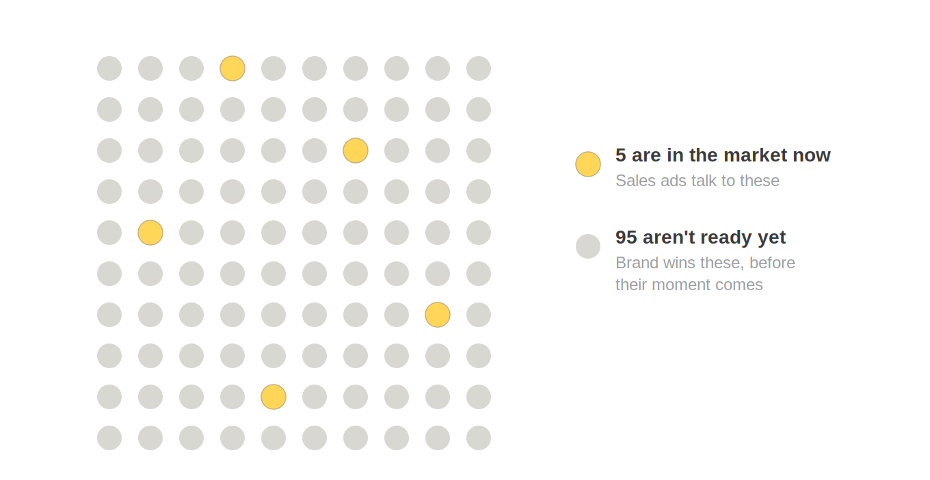
And there's a number that explains why. Researchers at the Ehrenberg-Bass Institute estimate that at any given moment, 95% of your potential buyers aren't ready to buy. They're not in the market this month. Sales ads only talk to the 5% who are. Brand communication is how you win the other 95%, so that when their moment finally comes, yours is the name already in their head.
The compounding effect
Brand communication compounds like interest. Every consistent message builds on the last one. Familiarity accumulates. Trust accumulates. Which means the brand work you do this year makes next year's sales ads work better: the person seeing your promotion already knows you, already has a feeling about you, and needs far less convincing.
To be fair, consistent sales campaigns do some of this work too. If your promotions show up regularly, carrying the same name, look, and voice every time, people will recognise you. Familiarity builds either way; every branded ad makes a small deposit in the market's memory. But look at what that familiarity is made of. If nearly every encounter with you is an offer, the market learns one thing about you: you're the one with the deals. That's recognition without preference. You get remembered for price and deals, and overlooked the rest of the time. Brand communication builds a different kind of memory: who you are, what you stand for, and why you're worth choosing when nothing is on sale.
That's why sales-heavy spending compounds weakly. The attention it buys is real, but most of it is rented by the offer and expires with the offer. And if your cost to acquire a customer creeps up every single year, while everyone around you is competing for the lowest price, that's not just “the market getting harder.” That's the bill arriving for the brand you didn't build, and it shows in what you pay for results.
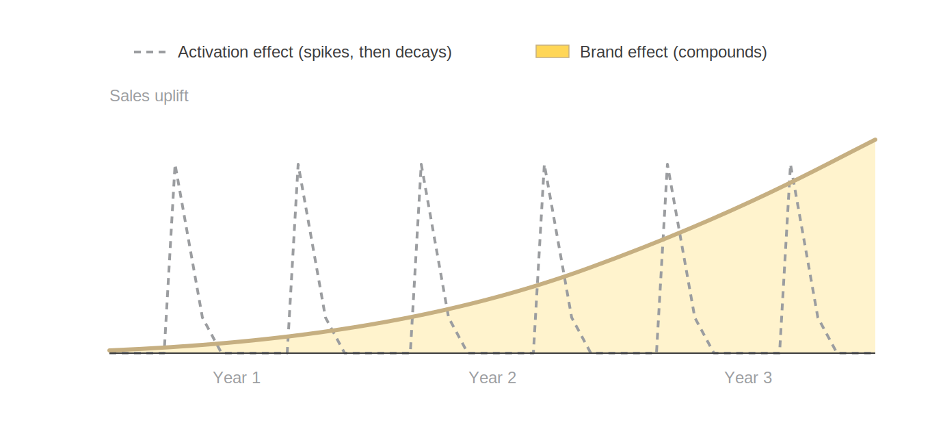
Illustrative: how the two effects behave over time. Based on the pattern documented by Binet and Field.
Two different rhythms
Part of doing both well is understanding that these two jobs run on completely different rhythms, and that's by design.
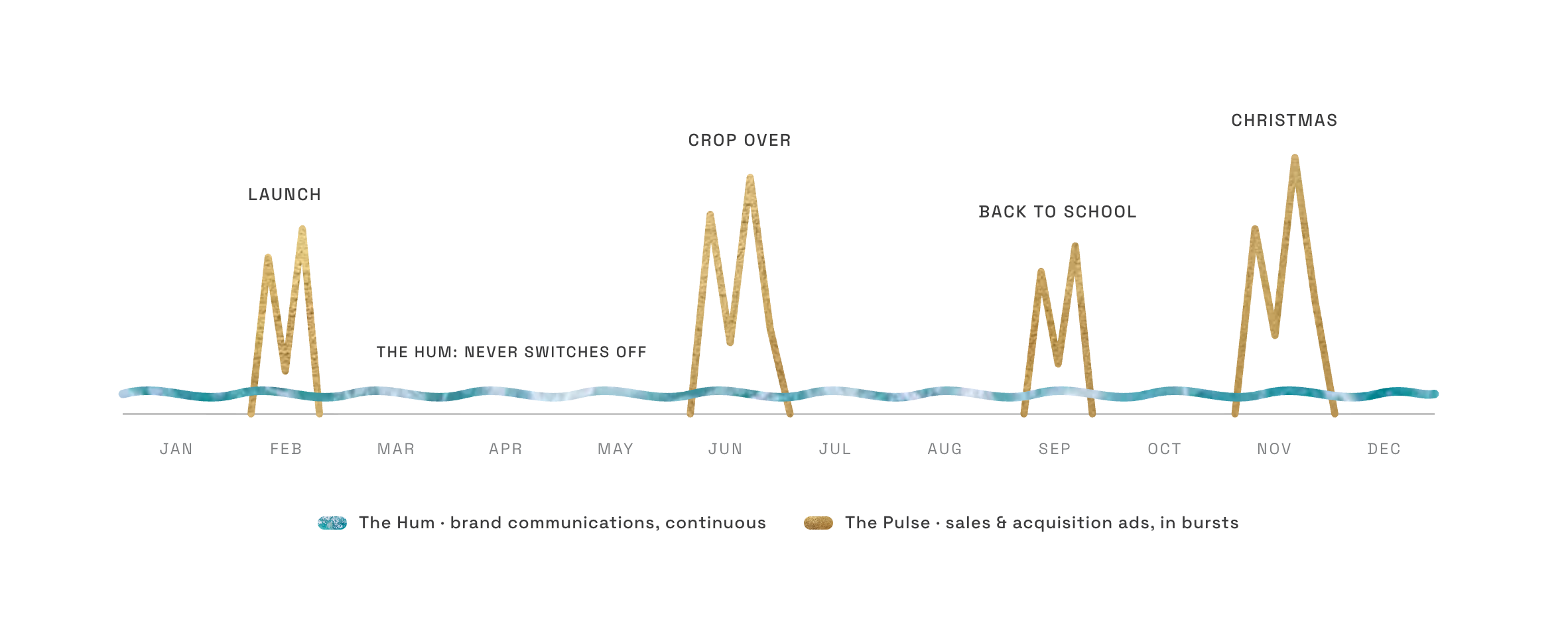
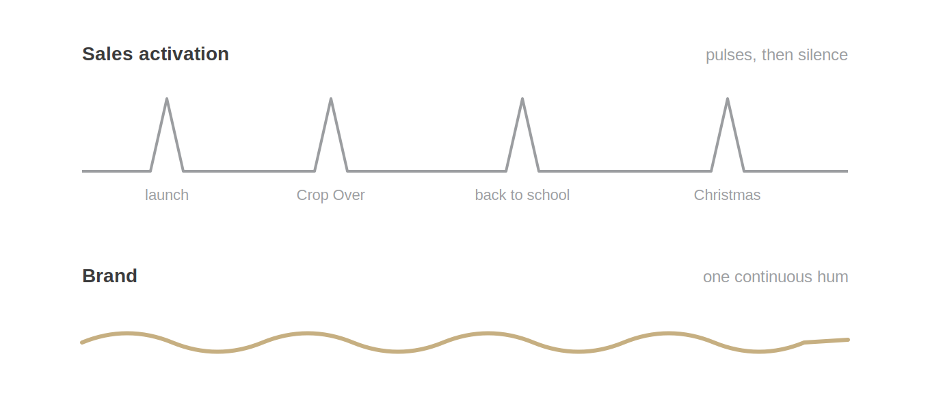
Sales and acquisition communication naturally comes in bursts. It's tied to a campaign, a season, a product moment: the Christmas promotion, the back-to-school push, the launch window, the end-of-quarter drive. It starts, it runs hard, it stops. And that's fine. It's exactly how activation is supposed to work. You show up loudly when the timing is right, and you go quiet when the moment passes.
Brand communication is the opposite. It's not a burst. It's a hum. One consistent presence running in the background, all year, every year. You might refresh the message once or twice a year, sharpen the story, update the creative. But the communication itself never switches off. The look stays the look. The voice stays the voice. The market never experiences a period where you simply aren't there. Seth Godin makes this point in This Is Marketing: people learn to trust what shows up consistently. Go quiet halfway, and you never earn the chance for the message to land.
Think of it like actual land (yeah, dust and grass). We all understand that land builds value by being held. Nobody buys a lot on Monday and sells it Friday; the value comes from keeping it, year after year, while it quietly appreciates underneath you. Brand works the same way. Every month of consistent presence adds to what you hold, without needing your constant attention. The worst thing you can do to an appreciating asset is keep trading in and out of it.
And that's the most common mistake we see: running brand comms on the campaign clock. Switching it on when there's budget, off when there isn't. On for the launch, then off after. Every switch-off resets the compounding, and every switch-on starts back the work of familiarity-building, almost from scratch.
Activation is allowed to pulse. Brand has to hum.
So how much should you actually spend?
Fair question, and there are real benchmarks, not just feelings.
Across the two most-cited annual studies, marketing budgets currently sit at just under 8% of company revenue (Gartner's survey, which leans toward very large enterprises) and about 9.4% (the Chief Marketing Officer Survey, run by Duke University with Deloitte, which includes a broader mix of company sizes). The United States Small Business Administration recommends 7–8% for smaller businesses. So for most established companies, somewhere in the range of 7–10% of revenue is the rational starting point.
The obvious pushback: those numbers come from American and British studies, so do they apply to a company in our region? They travel better than you'd think, for a simple reason. A percentage isn't a dollar figure. It scales to your reality automatically, so a business doing BBD $2 million and a business doing USD $200 million are being asked the same thing: let marketing grow and shrink in proportion to your revenue, whatever that revenue is. And the forces behind the numbers are just as present here, arguably more so. Your customers' attention is already being bought at international intensity, by the regional banks and telecoms, by the imported brands on every supermarket shelf, by the streaming and social ads on every phone in the country. You're not competing in a quieter room. You're competing in the same room, against companies that read the same research and budget accordingly.
Then adjust for two things.
Your industry. The averages hide enormous variation. Consumer packaged goods companies spend around 18% of revenue; energy companies spend closer to 3%. Business-to-business companies typically sit at 6–8% of revenue, while consumer-facing businesses spend around two and a half times more than their business-to-business counterparts. The logic in plain terms: the more crowded and consumer-facing your category, the more it costs to be remembered in it.
Your market position. Smaller and younger companies need to invest proportionally more, not less. Startups in their first couple of years often need 12–20% of revenue, because they're building awareness from nothing against established players who already own space in people's minds. And there's a long-standing finding in advertising research worth knowing: brands grow when their share of the conversation is bigger than their share of the market. A challenger trying to take ground has to out-communicate its size. A market leader can defend with proportionally less. Put simply: if you want to punch above your weight in the market, you can't whisper below it in your communication.
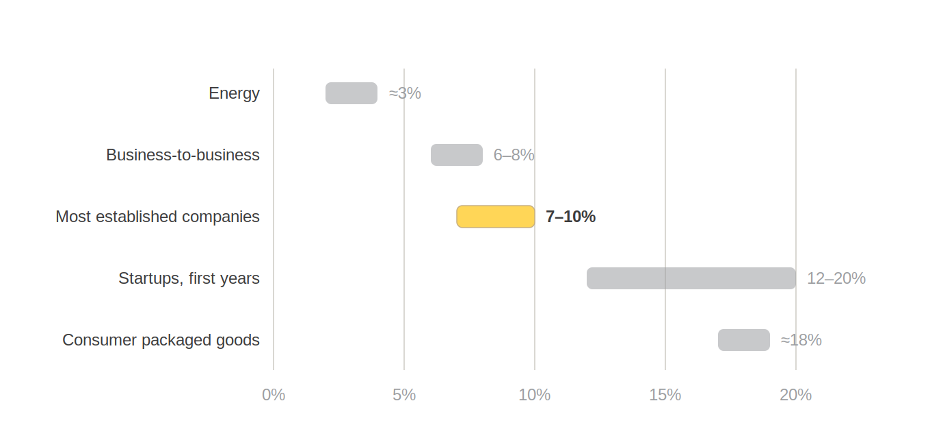
Marketing spend as a share of revenue. The gold band is the rational starting point.
Okay, let’s be real for a sec. Any regional CFO reading this already knows it: almost nobody here sets the budget as a percentage of anything. In most companies the marketing number is last year's number, nudged up or down by how the year is feeling, or simply what's left after every other line has eaten. The international benchmarks shown, land in this discussion as theory. But at least use them as a guide, as we can’t expect it to be a mandate. They tell you what the rest of the world considers, and that this region runs well behind convention. The realistic move is smaller, and it has three steps. Know your own number first; ask what last year's marketing spend actually was as a share of revenue, because some executives might not have seen it as a necessary calculation. Make this year's number a decision instead of a residual. And whatever the number turns out to be, protect it and give the ‘hum’ its seat inside the budget. A deliberate 2% beats an accidental 4%, because we can plan and work with a deliberate number.
And when money gets tight
Marketing is the first thing cut (yes, I said it). Research shows executives cut it before any other department nearly half the time. And yet Harvard Business Review analysed 4,700 companies through three recessions and found that only 9% came out the other side stronger than they went in. What set that 9% apart was balance: they cut costs selectively but kept investing in marketing while their competitors slashed.
Before we go further, let's be honest about who's making these cuts, because it's rarely carelessness. In this region especially, most businesses aren't spending investor money with a comfortable runway. They're bootstrapped. Invoice to invoice. Built by surviving another day, then another. And plenty of bigger companies coming off a year that didn't match the one before, where “do more with less” isn't a slogan, it's the instruction from the board. If the choice in front of you is genuinely marketing or payroll, make payroll. No argument, no lecture. Survival buys you the right to fight another day, and nothing in this article outranks that.
The problem isn't the survival cut. It's the habitual one: the company that cuts the budget every year, in good years and bad, while expecting better results every year. That doesn't make sense. It's asking the engine for more speed while draining the fuel tank. A shrinking budget doesn't just slow your growth. It hands your share of attention to whichever competitor kept spending.
Because attention is oxygen, and there's only so much of it in the room. Here's how the room works. Your customers create the air: the minutes they'll spend thinking about your category this year. That supply is roughly fixed, and no business can make more of it. Businesses don't make the air; they breathe it. Communication is how you inhale, and your budget is the size of your lungs, so deep pockets breathe deepest. And when you go quiet, the air keeps coming; it just all goes to the competitors still breathing, and each of them simply gets more of it. There's no vault where your unused attention waits until budgets recover. The room doesn't go quieter when you go silent; it just stops containing you. And re-entering costs more than staying did, because you come back rebuilding memory from zero, against someone who never stopped breathing.
So if you genuinely have to shrink the budget this year, shrink it like someone who intends to come back. Don't go silent. Get quieter. Keep the consistent message and look, because consistency costs almost nothing and it's what keeps your memory alive in the market. Hold one channel done well rather than five done thinly. Stay visible where your customers actually are, even if it's modest.
Why it’s tough for the smart executive
Because the deck is stacked. A sales ad produces a report by Friday. Brand produces a feeling, and feelings don't survive board meetings. Nobody ever got fired for funding the measurable thing, but…
Measurable and valuable are not the same thing. The cost of neglecting your brand is measurable. It just shows up next year, on different lines of the statement, under different names: rising advertising costs, growing price pressure, deals that take longer to close, customers who need more convincing every time.
What “doing both” actually looks like
None of this requires a huge team or a complicated framework. It requires four decisions.
Pick a message and a look, and stop changing them. Consistency is what makes brand spending compound. If you refresh your look every quarter, you're restarting the clock on your own familiarity.
Show up in front of your whole market, not just the people ready to buy this month. Remember the 95%. They're your next three years of revenue.
Judge brand work on the right clock. Weeks for sales ads; years for brand. The cleanest one is the quiet weeks: if inquiries still come in when nothing is on sale and no campaign is running, that's your brand working. If everything goes silent the moment the ads stop, you've been renting attention, not building memory.
Protect a slice of the budget. First set the overall size rationally: 7–10% of revenue, more if you're small or challenging upward. Then ring-fence the brand portion (the research points to about 60/40) so it can't be raided every time a quarter gets tight. If it can be raided, it will be.
Before anyone comes for me in the comments. One honest note before we close. I know how 60/40 reads from a boardroom chair in this region. Putting the bigger share toward brand runs against decades of habit, against where value has always been placed, and against a business culture that has long treated brand communication as a nice to have. Nobody has to flip a budget overnight, and I'm not pretending the ratio will survive the next board meeting unbruised. But I do ask, take the ‘Hum’ seriously. Healthy, consistent attention to brand communication matters far more than most executives here currently believe, and it deserves a protected seat in the plan, and not the scraps. Start by seeing it in a different light.
Without marketing, no one sees you. Without branding, no one trusts you. You need both. But more than that, you need them working together long enough to compound.
Talk it through with us
We'd be interested to hear your thoughts and your own thinking around this: where it matches what you've seen, and where it doesn't. Reach out to discuss further. We'd be happy to chat.
Sources and further reading
Thomas Smith, Successful Advertising (London, 1885). The original stage-by-stage account of repeated exposure, and the ancestor of the “Rule of 7.”
Les Binet and Peter Field, The Long and the Short of It: Balancing Short and Long-Term Marketing Strategies (Institute of Practitioners in Advertising, 2013). The analysis of 996 campaigns behind the 60/40 finding.
John Dawes, Ehrenberg-Bass Institute for Marketing Science, “The 95:5 Rule” (published with the LinkedIn B2B Institute, 2021). The estimate that around 95% of buyers are not in the market at any given time.
John Philip Jones, “Ad Spending: Growing Market Share,” Harvard Business Review (1990). The share-of-voice research behind “brands grow when their share of the conversation exceeds their share of the market.”
Gartner, annual CMO Spend Survey. Source for the enterprise budget benchmark of just under 8% of revenue.
The CMO Survey, directed by Christine Moorman, Duke University Fuqua School of Business, with Deloitte and the American Marketing Association. Source for the 9.4% budget benchmark, the industry and business-to-business breakdowns, and the finding that executives cut marketing before other departments 44.6% of the time.
United States Small Business Administration, marketing budget guidance for small businesses.
Ranjay Gulati, Nitin Nohria and Franz Wohlgezogen, “Roaring Out of Recession,” Harvard Business Review (2010). The study of 4,700 companies across three recessions.
Seth Godin, This Is Marketing (2018). On consistency, frequency, and trust.